The end is the same; it is the path that separates men.
The Way of Kings“The end is the same; it is the path that separates men.” is an ethical expression in The Way of Kings that turns mortality into a test of conduct. Its premise is not that goals are meaningless, but that a goal cannot justify every means of reaching it. Because all people eventually die, distinction lies in the road they travel: the burdens they accept, the harms they refuse, and the lives they preserve along the way.
Definition and First Formulation
Dalinar Kholin presents the principle through a story about travel. In the account, the traveler removes his sandals and places his callused feet on a table beside a partly eaten tray of grapes, provoking companions who take the gesture as proof that he is foolish. He then explains that the marks on his feet embody the journeys he has made. The image gives the expression its physical foundation: experience is not an abstract reward waiting at the end of a road, but something written into the body by the road itself.
The story acknowledges that the traveler could have moved more quickly. Speed, however, would not have altered the final destination. Everyone reaches an ultimate end, whether in a revered tomb or a pauper’s ditch; the passage explicitly exempts only the Heralds from this universal fate. The shared destination therefore cannot be the chief measure of a life. What separates people is the manner in which they arrive there, and the experiences, labor, and awareness accumulated during the journey.
Ethical Meaning
The expression becomes a warning against pursuing an admirable accomplishment by corrupt or unjust methods. Dalinar Kholin’s quoted conclusion states that no good can be achieved through false means and that existence derives its substance from method rather than achievement. The warning is directed especially toward a monarch: concentration on a desired result can draw attention away from the path required to reach it, making success itself morally compromised.
The principle therefore combines a consequence-based concern for what is achieved with a character-based concern for what the pursuit makes a person become. A victory gained through injustice is not redeemed merely because the outcome appears beneficial. The path is not decorative context around the destination; it is the substance by which the destination acquires, or loses, moral worth.
Connection to the Radiant Ideals
Teft later gives the same principle a more direct formulation while explaining the Ideals associated with the Knights Radiant. Under “Journey before destination,” he says that a goal can always be approached in several ways and that failure is preferable to winning through unjust means. His example makes the rule deliberately severe: protecting ten innocents does not justify killing one. The value of the lives at stake limits the means available even when the larger objective seems urgent.
Teft links the rule to the inevitability of death. Since all men die, the Almighty is presented as caring more about how a person lived than about what that person accomplished. In this context, “The end is the same; it is the path that separates men.” is not simply advice about patience or personal growth. It is a standard for Radiant action, requiring strength to become service and forcing noble intentions to submit to ethical restraint.
Dramatic and Narrative Function
The expression operates as a counterweight to military and political thinking, where victory can tempt leaders to measure decisions only by results. Its language of roads, feet, burdens, and destinations makes moral choice concrete: the traveler’s calluses are evidence that the route has shaped him. The contrast between a hallowed sepulcher and a pauper’s ditch also strips away social distinctions at the level of death, making rank unable to guarantee a different ultimate condition.
Its force is heightened by recurrence in distinct settings. Dalinar Kholin articulates the idea through reflective storytelling and political counsel, while Teft explains it as a practical rule for protectors. The first version emphasizes the meaning of lived experience and the danger of false methods; the second applies the same logic to immediate life-and-death decisions. Together they establish a durable contrast between accomplishment and the moral path used to obtain it.
Application and Significance
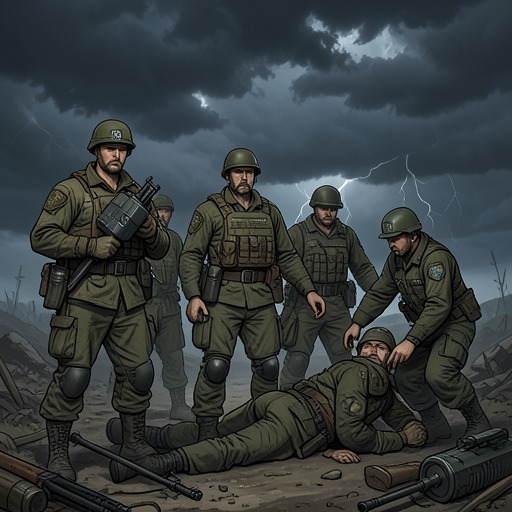
The expression’s clearest practical application appears when Kaladin Stormblessed saves Adolin Kholin during battle. After opening a route that allows the Cobalt Guard to advance and hold back the Parshendi, Kaladin Stormblessed tells Adolin Kholin that he has saved his life and demands that he order a retreat. Adolin Kholin wants to continue because Dalinar Kholin remains somewhere in the battle, but Kaladin Stormblessed points to the exhausted soldiers who can barely stand and the dozens being lost each minute.
This moment gives the principle an active, costly shape. Retreat may frustrate the immediate desire to find Dalinar Kholin, and it may appear to surrender ground, but continuing would spend soldiers who are already unable to fight. Kaladin Stormblessed treats preservation of life as more important than the appearance of relentless victory. The expression thus joins reflection to command: the path toward a military objective must remain accountable to the people forced to walk it.
As a recurring ethical formulation, the expression defines a standard by which actions, leaders, and emerging Radiants can be judged. It rejects the idea that a common ending makes all lives equivalent in moral meaning. Death may equalize destinations, but choices distinguish the journey, and the journey is where responsibility, integrity, and service become visible.